Search has changed more in the last two years than in the previous ten. People still type queries into Google, but they also ask voice assistants, chat with AI tools, and scan AI-generated summaries before they click anything. The brands that win in 2026 are not the ones chasing tricks. They are the ones that publish genuinely useful content, earn trust, and make their pages easy for both humans and machines to understand.
This guide covers the SEO strategies that actually work in 2026, organised around the six questions most site owners ask.
Quick answer: The SEO strategies that work in 2026 combine helpful, experience-led content, strong technical health, natural backlinks, and answer-first formatting that search engines and AI tools can easily quote.
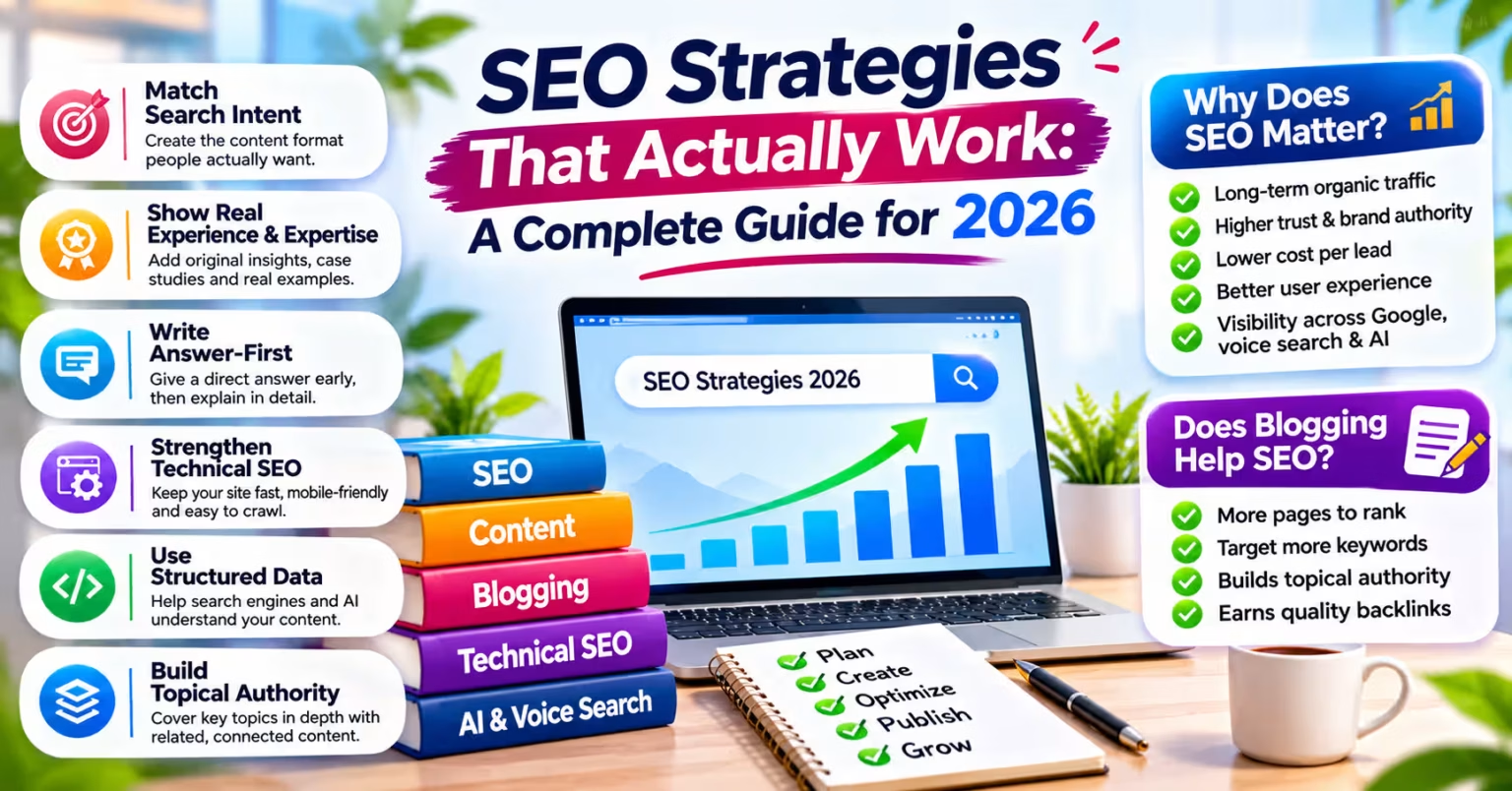
Why Does SEO Matter?
SEO Matters because search is still where most buying decisions begin. When someone needs a product, a service or an answer, they search first. If your page isn’t visible at that moment, a competitor’s is.
Unlike paid ads, which stop delivering the moment your budget ends, SEO builds an asset. A well-ranked article can bring qualified visitors for months or years. It also builds credibility, because people tend to trust brands that appear consistently in organic results.
In 2026, SEO matters for another reason: visibility now includes AI-generated answers. Content that is clear, accurate and well-structured is more likely to be cited by AI assistants, which extends your reach beyond the traditional list of blue links.
Key benefits of SEO:
- Consistent, long-term organic traffic
- Higher trust and brand authority
- Lower cost per lead over time compared with paid ads
- Better user experience through faster, clearer websites
- Visibility across Google, voice search and AI assistants
| Channel | Cost Pattern | Longevity | Trust Level |
|---|---|---|---|
| SEO | Upfront effort, low ongoing cost | Long-term | High |
| Paid ads | Continuous spend | Stops when budget stops | Medium |
| Social media | Time and content heavy | Short to medium | Medium |
Which SEO Strategy Works Best?
There is no single winning tactic, but one principle sits above the rest: create content that fully satisfies search intent, and support it with a technically sound site. Everything else amplifies that foundation.
Here are the strategies that deliver the most consistent results in 2026.
1. Match search intent precisely.
Before writing, look at what already ranks for your target query. Is it a guide, a comparison, a product page or a quick answer? Build the format people clearly want, then make yours more complete and more useful.
2. Show real experience and expertise.
Google’s quality guidelines emphasise experience, expertise, authoritativeness and trust. Add author bios, original examples, case studies, screenshots and first-hand insights. Generic, recycled content struggles to stand out.
3. Write answer-first.
Put a direct answer in the first two lines under each heading, then expand. This helps featured snippets, voice assistants and AI tools extract your content accurately.
4. Strengthen technical SEO.
Fast loading, mobile-friendly design, clean URLs, a logical site structure, secure HTTPS and crawlable pages are the baseline. Without them, great content can still underperform.
5. Use structured data.
Schema markup for articles, FAQs, products, reviews and organisations helps search engines interpret your pages precisely.
6. Build topical authority.
Instead of publishing scattered posts, cover a subject in depth with a main pillar page supported by closely related articles that link to each other.
| Strategy | Effort | Impact | Best For |
|---|---|---|---|
| Intent-matched content | Medium | Very high | Every website |
| Technical SEO | Medium | High | Sites with speed or crawl issues |
| Structured data | Low | Medium to high | Businesses wanting rich results |
| Topical authority | High | Very high | Long-term growth |
| Link building | High | High | Competitive niches |
Does Blogging Help SEO?
Yes. Blogging is one of the most reliable ways to improve SEO, but only when the posts are useful. A blog gives you more pages that can rank, more keywords you can target, and more opportunities to earn links and answer real questions.
Each well-written post is a new entry point to your website. Over time, a library of quality articles also signals expertise on a topic, which supports your whole domain.
However, publishing volume alone doesn’t work. Thin posts written only to hit a posting schedule rarely rank, and a large amount of low-value content can drag down overall site quality.
How to make blogging work for SEO:
- Target one clear topic and intent per post
- Answer the main question early, then go deeper
- Include original insight, data or examples
- Link internally to related posts and key service pages
- Update older posts regularly so they stay accurate
- Add clear headings, short paragraphs and scannable lists
| Blog Practice | SEO Effect |
|---|---|
| Regular, quality publishing | Builds topical authority |
| Internal linking | Spreads authority and aids crawling |
| Content refreshes | Maintains rankings and freshness |
| FAQ sections | Captures question-based searches |
| Thin or duplicate posts | Can harm site quality |
Should You Use Long-Tail Keywords?
Yes, in almost every case. Long-tail keywords are longer, more specific phrases, such as “best project management tool for small design teams” instead of “project management tool.” They usually have lower search volume but much clearer intent and less competition.
Because the searcher knows exactly what they want, long-tail traffic often converts better. A person searching a specific phrase is typically closer to a decision than someone typing a broad term.
Long-tail keywords also fit the way people now search. Voice queries and AI chat prompts are conversational and detailed, which makes natural, specific phrases more valuable than ever.
How to find and use long-tail keywords:
- Review Google’s autocomplete suggestions and “People also ask” boxes
- Check the questions customers ask your sales and support teams
- Use keyword tools to filter for lower-competition phrases
- Include variations naturally in headings, intros and FAQs
- Avoid stuffing; write for the reader first
| Keyword Type | Example | Competition | Intent Clarity |
|---|---|---|---|
| Short-tail | “SEO” | Very high | Low |
| Mid-tail | “SEO strategies 2026” | High | Medium |
| Long-tail | “SEO strategies for small local businesses” | Lower | High |
Are Backlinks Important for SEO?
Yes, backlinks remain one of the strongest trust signals in search. A link from a respected, relevant website acts like a recommendation. When many credible sites point to your content, search engines treat it as more authoritative.
Quality matters far more than quantity. A handful of links from relevant, trusted sites is worth more than hundreds from low-quality directories. Manipulative tactics, such as buying links or joining link schemes, carry real risk and can lead to penalties.
The most sustainable approach is to earn links by creating something worth referencing.
Safe, effective ways to earn backlinks:
- Publish original research, surveys or data others want to cite
- Create practical tools, templates and checklists
- Contribute expert commentary and guest articles on relevant sites
- Build relationships through digital PR and partnerships
- Reclaim unlinked brand mentions by asking for a link
- Fix broken links on other sites by offering your relevant page
| Backlink Quality Factor | Strong Signal | Weak Signal |
|---|---|---|
| Relevance | Same or related industry | Unrelated site |
| Authority | Established, trusted source | Spammy or new low-quality site |
| Placement | Within editorial content | Footer or sidebar clutter |
| Acquisition | Earned naturally | Purchased or exchanged in bulk |
Will AI Change SEO Strategies ?
AI is already changing how people search and how results are displayed, but it is not replacing SEO. It is raising the bar.
AI-powered search features summarise answers and cite sources. That means being the clearly best source on a topic matters more than ranking for a keyword alone. Practices often grouped under AEO (answer engine optimisation) and GEO (generative engine optimisation) focus on making content easy for AI systems to understand, trust and quote.
At the same time, AI tools make it easy to produce huge amounts of mediocre content. Search engines continue to reward originality, accuracy and real expertise. Using AI to assist research, outlines or editing can help, but publishing unedited, generic output rarely earns lasting visibility.
How to adapt your SEO for an AI-driven search landscape:
- Lead with clear, concise answers to specific questions
- Use descriptive headings, short paragraphs and well-labelled tables
- Add schema markup and keep facts accurate and up to date
- Show real authorship, credentials and first-hand experience
- Build a recognisable brand, since people increasingly search for names they trust
- Track visibility beyond rankings, including brand mentions and AI citations
| Traditional SEO Focus | 2026 Adaptation |
|---|---|
| Keyword rankings | Rankings plus AI answer visibility |
| Keyword density | Topic depth and semantic coverage |
| Click-through from results | Brand recognition and being cited |
| Generic content | Original, experience-led content |
Conclusion
The SEO strategies that actually work in 2026 are less mysterious than the industry often makes them sound. SEO matters because search, in all its new forms, is still how people discover solutions. The best strategy is to satisfy search intent with expert, experience-led content on a technically healthy site. Blogging helps when each post earns its place. Long-tail keywords capture specific, high-intent searchers. Quality backlinks continue to build authority. And while AI is reshaping how results appear, it rewards the same fundamentals: clarity, accuracy and trust.
Start with a few practical steps: audit your technical health, map your content to real questions, add answer-first sections and structured data, and build links by creating things worth citing. Consistency over six to twelve months will do more for your visibility than any shortcut.
- What Are the Best SEO Strategies That Actually Work?
- How Does SEO Work in 2026?
- Why Is SEO Important for Website Growth?
- How to Improve Website SEO Rankings?
- Which SEO Techniques Work Best for Beginners?
- What Are the Most Effective On-Page SEO Strategies?
- How Can You Improve Organic Website Traffic?
- Does Keyword Research Still Matter for SEO?
- What Is Technical SEO and Why Does It Matter?
- How Long Does SEO Take to Show Results?

Amazing post thanks to share brother